
Part one by Michael G Parry-Thomas
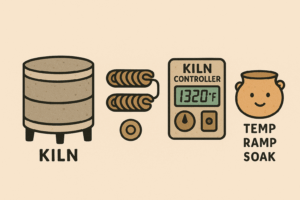
🚀 PotteryTech Kiln Simulator: Quick Start Guide (Click to Open)
▼1. Set Your Schedule (The Controller)
Choose your mode on the left panel:
- Cone Mode: Auto-calculates temp (e.g., select Cone 04 for Biscuit).
- Ramp Rate: How fast heat rises.
Safe: 60°C–100°C/hr.
Danger: >150°C/hr (Risk of steam blowouts!).
2. Check Hardware (The Sliders)
Simulate the age of your elements:
- 100%: Brand new. Firing is efficient.
- < 50%: Old/Worn. Watch the graph—the Red line may “stall” and fail to reach target.
3. Simulation Speed (⏱️ Important)
Located above the kiln view:
- Real-Time Runs second-by-second. Best for watching PID power adjustments.
- Hyper (Default) Compresses 8 hours into ~30 seconds. Use this to quickly generate the Analysis Report.
4. Fire & Analyze
Press ▶ START. If the pots turn into a 💥 symbol, you fired too fast! Scroll down for the final Analyst Report.
🎓 What You Will Learn
- The Moisture Limit: Why “Bone Dry” matters. Firing wet clay >100°C/hr causes explosions.
- Heat Work: Why temperature + time (Soak) creates a mature firing.
- Hardware Diagnostics: Recognize failing elements before they ruin a real firing.
A Simple Guide to Kiln Firing: Ramp, Soak, and Load (Thermal Mass)

Firing ceramics in a kiln is a bit like baking, but instead of just setting a temperature, you control the entire journey of heating up and cooling down. Getting this journey right is the key to turning soft clay into a strong, beautiful finished piece. Let’s break down the main ideas.
The Basic Concepts
· Ramp Rate: This is simply the speed at which you heat the kiln. It’s measured in degrees per hour (°C/hr or °F/hr). A “slow ramp” means heating up gradually; a “fast ramp” means heating up quickly.
· Soak (or Dwell): This is a pause in the firing. Instead of continuing to heat up, you tell the kiln to hold at a specific temperature for a set amount of time. This allows heat to spread evenly throughout the kiln and gives important chemical changes in the clay and glaze time to finish.
· Thermal Mass: This is a fancy term for how much “stuff” is in the kiln. A kiln full of thick, heavy pots has high thermal mass—it takes longer to heat up and cool down. A kiln with just a few small items has low thermal mass—it heats and cools quickly.
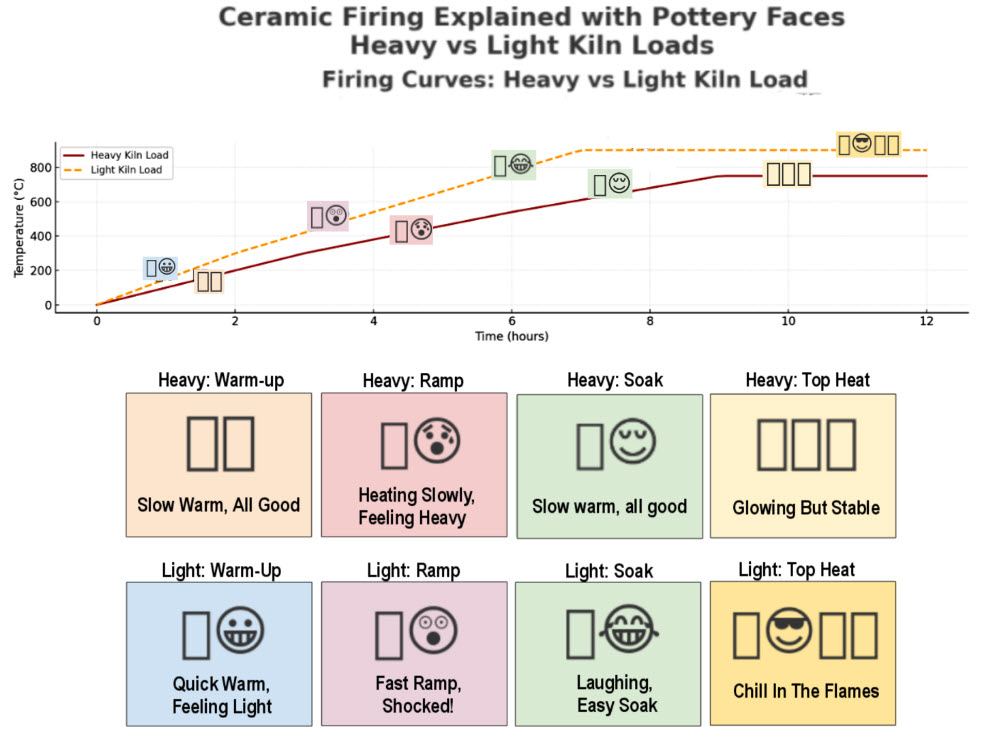
Why It All Matters: The “Pot with a Face“
Imagine a ceramic mug with a sculpted face on it—it has delicate features like eyelids and lips, and thicker areas like the cheeks and forehead.
· The thin areas (lips, eyelids) heat up and cool down very quickly.
· The thick areas (cheeks, forehead) heat up and cool down much slower.
If the kiln heats too fast, the thin parts can expand and contract much faster than the thick parts, creating stress. This stress can lead to cracking, warping, or even parts breaking off. Controlling the ramp and soak helps the entire piece heat evenly, preventing these problems.
How Your Kiln Load Changes Everything
The amount of pottery in your kiln (the load) is the biggest factor in deciding your ramp and soak settings.
- Firing a HEAVY Load (Lots of pots, thick pieces)
· Think of it like: Baking a large, thick roast. You need to cook it low and slow so the inside is done before the outside burns.
· Ramp Rate: Use a slower ramp. This gives heat time to penetrate all the heavy ware. A fast ramp could cause the outside of the pots to be much hotter than the inside, leading to cracks.
· Soak Time: Use longer soak times. This gives the heat time to even out everywhere inside the kiln, ensuring everything from the smallest to the largest piece reaches the right temperature.
- Firing a LIGHT Load (A few smaller items)
· Think of it like: Making toast. It heats up very quickly and doesn’t need to sit in the toaster for long.
· Ramp Rate: You can safely use a faster ramp. With less material to heat, the temperature rises quickly and evenly.
· Soak Time: You often need very short or even no soak time. The heat spreads quickly, so there’s less risk of uneven temperatures.
Putting It All Together
Your goal is to balance the ramp speed and soak time based on your kiln’s load to apply the right amount of “heatwork” to your pottery.
· Too fast a ramp on a heavy load? Risk of cracks and breaks.
· Too short a soak on a heavy load? The inside of a thick piece might not be fully fired, while the outside is over-fired.
· Too long a soak on a light load? Risk of over-firing, making glazes runny or surfaces blistered.
One Final Pro Tip: Drying is Key!
Before you even start your main firing, it’s crucial to remove all moisture from the clay. Any trapped water will turn to steam and can make pieces explode.
Always use a drying program: a very slow ramp (e.g., 50°C/hr) to a low temperature like 100°C, and then hold it there for an hour or two. This safely bakes out all the water and protects your pottery from disaster.
By understanding these simple concepts—ramp, soak, and load (Thermal Mass) heatwork—you can fine-tune your kiln firings and create beautiful, successful ceramics every time..
Kiln Firing Log book
Plan, log, and visualize your kiln firing cycles
Handout by Michael G Parry-Thomas · PotteryTech.net